
BIO-POTENTIAL OF MICROALGA Botryococcus braunii AS AN ECO-FRIENDLY BIODIESEL FUEL FOR FUTURE RENEWABLE BIOENERGY
Indonesia is a megabiodiversity country with a high level of flora and fauna diversity in the world. The high level of diversity can be seen in the various unique organisms that live in Indonesia, especially marine organisms. One of the interesting marine organisms to study is microalgae. Microalgae are unicellular species that are able to live solitarily or colonies and have photosynthetic pigments that are able to use sunlight and carbon dioxide to produce biomass along with oxygen to the atmosphere (Assadad et al, 2010). Microalgae have a variety of benefits and potential if further developed in research. Microalgae research is still being promoted, one of which is in producing renewable biodiesel energy from the microalgae Botryococcus braunii (Figure 1).

Indonesia’s Ministry of Energy and Mineral Resources states that in 2021, it is estimated that the national fuel oil (BBM) consumption will reach 75.27 million kilo liters (kL), which includes gasoline, diesel, kerosene, and biodiesel. Biodiesel is chemically composed of long-chain alpha alkyl esters due to the reaction between lipids and alcohol. The potential utilization of Botryococcus braunii microalgae as an environmentally friendly biodiesel is very prospective if it continues to be carried out. Microalgae have several advantages in the form of easy cultivation, large biomass production and good adaptability (Yaashikaa et al, 2022). This is also supported by research from Zabed et al (2020) which revealed that microalgae can produce 15-300 times more biodiesel than plants. In addition, the harvest cycle of microalgae is also relatively shorter, for at least 10-15 days, so it is very prospective to be studied.
Botryococcus braunii microalgae cultivation can be divided into two ways, namely open system and closed system. Open system In this system, the size capacity is: 0.7-10 m2 (203-2000 L) and 1 m2 (287 L) for microalgae cultivation ponds. The open system cultivation system is a photoautotrophic type cultivation on a synthesized medium with CO2 as the inorganic carbon source, thus making commercial application limited. However, 18 days of cultivation time was enough to produce about 1.85 g/L of Botryococcus braunii biomass. The mixing process has a major influence on the quantity and quality of lipid products from microalgae. The optimal mixing rate is 15 rpm which will induce 20-24% lipid content with 34% oleic acid. In addition, mosquitoes can also greatly affect the outdoor biomass production of Botryococcus braunii if the nutrient medium is not supplemented with 0.5 M NaCl (Ahmad et al, 2022). Meanwhile, the closed system cultivation system carried out by photobioreactor is implemented by using suspended microalgae cells. Botryococcus braunii cells were cultivated in panels and plastic bags (Chen et al, 2019). In the closed system, a capacity of 400-1000 L and 200 L for panels and plastic bags, respectively, was used. Each specifically, has been used only for cultured cells while immobilized cells are still in laboratory scale. Like the open system, all experiments were conducted using synthetic media with CO2 as the inorganic carbon source and fertilizers (Feng et al, 2016). Closed-system biofilm cultivation gave significantly lower biomass productivity than the open system, but the highest (5.5 g/(L day)) among the closed systems. However, the maximum productivity of lipids was 20.36 g/(L day) obtained with the plastic bag photobioreactor under outdoor ultrasonic treatment conditions. All of these studies indicated that linoleic and oleic acids as the main components of lipids.
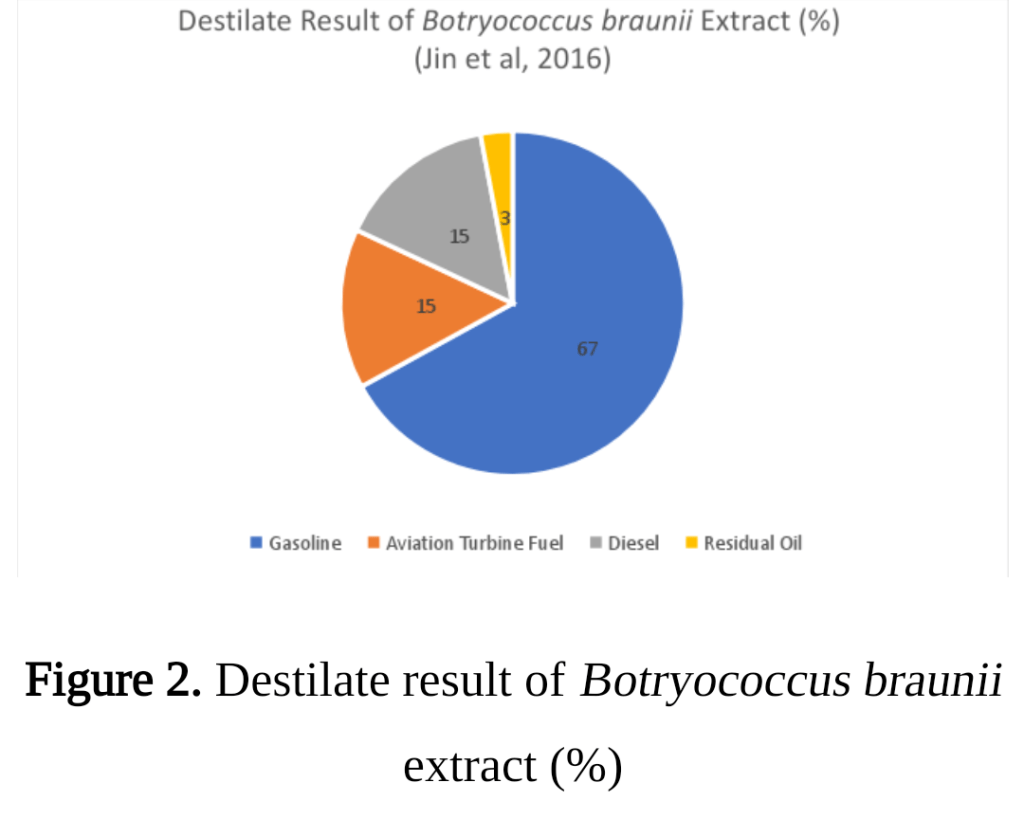
Ruangsomboon et al (2015) reported that the lipid content of Botryococcus braunii was 49.94 ± 0.82%. The fatty acid composition is also suitable for biodiesel production, which is around 58.30-66.82. Research conducted by Jin et al (2016), obtained a distillate consisting of 67% gasoline, 15% aviation turbine fuel, 15% diesel, and 3% residual oil (Figure 2). While in the research of Thurakit et al (2022), stated that the microalgae Botryococcus braunii contains long-chain fatty acids (C16-C18). In addition, it can supply 3.5% of transportation fuel and transportation fuel and requires 17.000 km2 of land for 850 PJ/year production (Feng et al, 2016).
Energy-related needs are a problem experienced by many countries. Increasing environmental problems due to high carbon dioxide (CO2) concentration in the atmosphere is one of the consequences of using fossil fuels. Botryococcus braunii is a very promising biodiesel feedstock due to its high lipid content and can reduce CO2 in the atmosphere. In addition, this microalgae can also be cultivated on non-agricultural land or in aquatic environments using wastewater by recycling nutrients in the form of nitrogen obtained from the remaining conversion to biodiesel. This research has the potential to be developed in Indonesia. This is because the factors that affect the cultivation of Botryococcus braunii microalgae such as temperature, pH, and supply of sunlight and CO2 are in accordance with Indonesia’s natural conditions.
Reference
- Ahmad, S., K. Iqbal., R. Kothari., H.M. singh., A. Sari., V.V. Tyagi. 2022. A critical overview of upstream cultivation and downstream processing of algae-based biofuels: Opportunity, technological barriers and future perspective. Journal of Biotechnology, vol. 351, hal. 74-98
- Assadad, L., Utomo, B., and Sari, R. 2010. Pemanfaatan mikroalga sebagai bahan baku bioetanol. Squalen, 5(2): 51-58.
- Chen H, Li T, Wang Q. 2019. Ten years of algal biofuel and bioproducts: gains and pains. Planta; 249(1):195–219.
- Feng, P.Z., Zhu, L.D., Qin, X.X., Li, Z.H., 2016. Water footprint of biodiesel production from microalgae cultivated in photobioreactors. J. Environ. Eng. 142 (12), 04016067.
- Jin, J., C. Dupre., K. Yoneda., M.M. Watanabe., J. Legrand., D. Grizeau. 2016. Characteristics of extracellular hydrocarbon-rich microalga Botryococcus braunii for biofuels production: Recent advances and opportunities. Process Biochemistry, 51, 1866-1875.
- Ruangsomboon, S. 2015. Effects of different media and nitrogen sources and levels on growth and lipid of green microalga Botryococcus braunii KMITL and its biodiesel properties based on fatty acid composition. Bioresource Technology, 191, hal. 377-384.
- Thurakit, T., W. Pathom-aree., C. Pumas., T.W. Brocklehurst., J. Pekkoh., S. Srinuanpan. 2022. High-efficiency production of biomass and biofuel under two-stage cultivation of a stable microalga Botryococcus braunii mutant generated by ethyl methanesulfonate-induced mutation. Renewable Energy, 198, 176-188.
- Yaashikaa, P., Devi, M., Kumar., Pandian, E. 2022. A review on biodiesel production by algal biomass: outlook on life cycle assessment and techno-economic analysis. Fuel, 324, 124774.
- Zabed, H.M., Akter, S., Yun, J., Zhang, G., Zhang, Y., Qi, X., 2020. Biogas from microalgae: technologies, challenges and opportunities. Renew. Sustain. Energy Rev. 117, 109503.
FACULTY OF SAINS AND TECHNOLOGY
AIRLANGGA UNIVERSITY
2023
 Biology Essay